Netherlands 0-0 Germany - Tactical Review

Not a match for fans of highlight reels, this was characterised by tactical discipline and defensive diligence. Louis van Gaal, conscious of the threat posed by Germany’s fluid front four, set up with a deep 4-1-4-1 formation aimed at closing off space and kept this shape throughout. Van Gaal also elected to have his full-backs and central midfielders man-mark their direct opponents – an interesting policy, given that the latter positions were filled by Ibrahim Afellay and Rafael van der Vaart, men hardly renowned for their ability to put in a defensive shift. The plan, however, was a success, with the two remaining organised and tight to their men as well as displaying their obvious quality on the ball.

The key tactical point for Germany was the selection of a front four containing no number nine. Mario Götze and Marco Reus spent most of the match interchanging as the notional number nine, making darting runs between the full-backs and centre-backs and creating space for the ever astute Thomas Müller to exploit. Lewis Holtby played a slightly more conservative role, taking possession in advanced positions and recycling. The system of interchange worked well in periods and could have created a goal for Reus after twenty-seven minutes, but van Gaal’s plan was more than its equal. Germany could perhaps have done with involving Lahm more in attacking play, but given the threat posed on the counter his conservative display was understandable.

Both teams were keen to attack at set pieces, moving more men forward on those occasions than at any time in open play, but there was still no clear chance created from them either directly or on the counterattack. The most notable set-piece in the match was the corner which Marco Reus comically shanked almost directly upwards.

Van Gaal’s reactive setup resulted in the lion’s share of early possession being taken by Germany’s centre-backs, Per Mertesacker and Mats Hummels. This largely played into Dutch hands: twice during the first eleven minutes Hummels was sufficiently tempted to try long killer passes and lost possession on both occasions. Between the tenth and thirtieth minutes Bruno Martins struggled somewhat due to a lack of cover from Arjen Robben, but eventually he settled into the game and Robben began to help the Feyenoord youngster.

Germany were comfortable being the proactive side and despite the lack of clear chances fashioned, one sensed in their young attackers a belief that their system would win out against the obstinate Dutch defence. Thomas Müller and Lewis Holtby, in particular, never shied from receiving the ball and trying to make something happen. İlkay Gündoğan caught the eye, his replication of Bastian Schweinsteiger’s national team performances more than passable. Indeed, on thirty minutes it was a little too good: he, along with his midfield partner Lars Bender, were too high up the pitch and were slow to close down the advancing Rafa van der Vaart. The Hamburg man skipped between them and his pass sent Arjen Robben through on goal. The Bayern winger rounded Manuel Neuer but found Benedikt Höwedes on hand to block his goal-bound shot.

This was an atypical moment in terms of first-half tactics: the Dutch approach then was to sit deep and wide and get narrow once the ball was inside their own half, the thinking presumably being that their best chance of success lay on the counter with the pace of Robben and Ruben Schaken.

Löw’s men were happy to keep the ball at the back, relying on the movement of their front four tying knots in the Dutch man-marking before working the ball forward, mostly down the right, in fast transitions. This produced a couple of half-chances, but like their opponents’, their best scoring opportunity came from a moment out of keeping with the general tactical trend. At the end of the first half, Gündoğan made a skilful foray into the Dutch area and, despite losing the ball, remained forward to slam the ball goalward when it broke in the ensuing scramble. Unfortunately for the Dortmund man, Johnny Heitinga had read the danger and blocked the shot on the line.

The second half began with several substitutions from van Gaal and a change in tact from Jogi Löw. His side sat much deeper and invited the Dutch onto them. Given the trouble the Germans had finding space to attack in the first half, this made sense. At the beginning and end of the half, it also allowed the Dutch to take possession closer to Manuel Neuer’s goal, but there was little significant danger. For the most part, Germany enjoyed the majority of the ball. Despite looking potent in periods, their domination was mostly sterile.

As is typical of the twenty-first century international friendly, the myriad of substitutions in the second half prevented any flow developing. Most of the clearest shooting chances fell to the Netherlands. On seventy-six minutes Gündoğan and Bender were again caught too high up the field, causing Hummels to charge out of the defensive line. This in turn allowed the Netherlands to break down the right, and Schaken’s cutback was met by the substitute Daryl Janmaat, whose twenty-yard drive was saved by Neuer. Germany looked vulnerable again a minute later, but Eljero Elia’s shot from the left channel was wildly inaccurate. In the last minute, Marco Reus had the chance to win it following a poor headed clearance, but like Elia minutes before, he ballooned the ball high and wide. The final whistle followed shortly thereafter.

Whether van Gaal or Löw won the tactical battle is open to dispute and arguably irrelevant. The information that both camps gleaned from the ninety minutes will be largely positive. Van Gaal’s side looked organised and tough but in a different manner to the sides of his predecessor. Löw gave valuable game time to youngsters like Gündoğan, Holtby and Götze and will be pleased at their respective performances which, despite the occasional youthful error, were mature and encouraging. This was a match of little spectacle but it contained more than enough evidence of progress being made by both sides.

Rob Brown

Four million people watch England game they don’t care about

The following is all lies. But, in the end, isn't that the real truth?


An average of 4.08 million fans who don’t care about international football tuned in to England’s friendly in Sweden last night, according to figures from the Broadcaster’s Audience Research Board.

ITV1’s coverage of the 1-1 draw in Stockholm, a game that also marked a 100th England appearance for popular dickhead Steven Gerrard, drew a peak audience of 4.32m fans who hate the international break, many of whom took to Twitter to express their lack of interest in the match.

“Why are we watching this again? #pointless #dontcare” tweeted one fan who probably wears a replica shirt with his name on the back.

Another shitmuncher, whose avatar bore the legend ‘Keep Calm and Sack Wenger’, wrote: “Fuck sake there was a #England game like two weeks ago. #Wilshire looking world class tho #Arsenal”.

The average of 4.08 million uninterested viewers represents a substantial increase on the previous friendly, a win over Italy seen by only 3.42 million people, all of whom had better things to do with their evening.

International friendlies, which take place on three evenings a year, are widely regarded as an intolerable distraction from the club game. Supporters’ rights groups have reported a record number of complaints from fans frustrated at the gap of almost a week between televised Premier League games. A hastily released leaflet from the FA lists ways in which fans can avoid international football. These include changing the channel, making a sandwich and doing literally anything other than watching football on three specified evenings each year.


Charlie Anderson

Reasons to be Cheerful

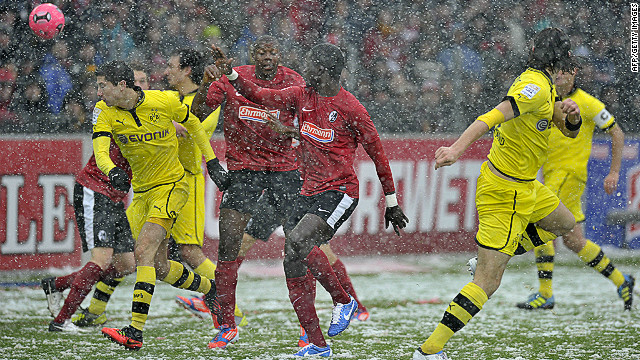
Freiburg vs Dortmund: great fun. Photo: AFP/Getty
Here in the UK, it has apparently been a pretty miserable week to be a football fan. Four of the five British sides were defeated in the Champions League – the worst set of results in the competition for a decade. There was the Arsenal AGM, widely portrayed as a depressingly familiar farce in which a group of disconnected rich white men flaunted their disregard for popular opinion. The weekend brought yet another racism scandal which threatens to dominate mainstream coverage for the foreseeable future. Yesterday, there came the final insult and possibly the most horrendous of all: news that Lee Cattermole will remain a highly-paid pseudo-footballer instead of maximising his potential as a mixed martial artist.

Despite this and the best efforts of many journalists, pundits and tweeters, I remain as deeply in love with football as ever. So we all do. Here are a few reasons why the last week has been undoubtedly brilliant to be a football fan.

Freiburg vs Dortmund
Probably the best weather-influenced match since Switzerland vs Turkey broke new ground in the genre at Euro 2008. Six inches of snow fell in Freiburg over the weekend and the match was played in the middle of the blizzard. Despite the inevitably low level of quality on show – one first-half graphic informed me that pass completion was currently 51% vs 61% – it was impossible to be bored. The snow denied Freiburg two goals in the first half, most brilliantly when Daniel Caligiuri drew Roman Weidenfeller from his goal and rolled the ball across for Karim Guedé to tap into an unguarded net, only to see his would-be assist stop dead in the snow and allow Dortmund to clear. Ninety minutes of slapstick comedy, topped off by a brilliant goal from Mario Götze.

Schalke’s continued emergence
Saturday’s win over Nürnberg , courtesy of Jefferson Farfán’s third goal of a personally productive start to the season, took their tally of consecutive victories to four. However, it is not the number of their wins which is startling, but who it is that they’re beating: defeat of Dieter Hecking’s men came after wins against Dortmund at the Westfalenstadion and Arsenal at the Emirates. The ingredients for success are all in place for Huub Stevens' Königsblauen and if they can sustain their recent form then they will certainly be in with a chance of taking the Bundesliga title for the first time since 1958.

Roma vs Udinese
An absolutely mental game of football. Five goals, each due to tremendous combination play and defending that would’ve shamed Gaël Clichy, and settled by a Panenka from the ageless Totò di Natale. Personally, I prefer a tactical 1-0 in which everyone posts 85% pass completion or higher, but for those “falling out of love with the game”, this was the ideal tonic.

Dimitar Berbatov
A perceived lack of effort from the Bulgarian earned him criticism from the Guardian’s Sachin Nakrani and Match of the Day’s John Roder this weekend. For them, it was simply not enough to complete more passes than all but two players on the pitch, win more free-kicks than any other player on the pitch, have more shots than any other striker on the pitch and cap it all with a goal of genuine beauty. For me, however, that’ll do.

Stoke have won just one of their last fifteen Premier League matches
Fuck Stoke.

Juan Carlos Valerón’s continued brilliance (pt. 2,429,136)
Fresh from filming an underreported role as Ben Affleck’s stunt double in upcoming thriller Argo, Europe’s answer to Juan Roman Riquelme was close to his mesmeric best in Deportivo’s draw with Celta. Depor’s start to the season may have been wretched, but when you’ve got a thirty-seven year-old club hero making assists like his for Juan Domínguez, you can forget that just for an instant and reflect on what the game is really about: fun. And boy, was that assist fun.

Cholo's Atlético go on and on
Falcao’s is the name on everyone’s lips, but it’s arguably the strength of the Colombian’s supporting cast which creates the belief that they’re not another Levante waiting to happen. The weekend’s win included the customary goal for El Tigre, but this time his was the icing on the cake rather than the decider, with goals from Miranda and Raúl García doing for a thoroughly outplayed Osasuna. There are clear issues in defence, with only three clean sheets registered in La Liga so far, but their abundance of attacking riches has combined with a clearly Simeone-influenced midfield to floor opponent after opponent. The elephant in the room is that Atlético will once again have to sell the crown jewels at the end of the season in order to keep going. That is a long time away, though. For now, it is better to sit back and watch Simeone’s men at the peak of their powers.

Sergio Busquets’ nomination for the Ballon d'Or
Given the inevitability of Lionel Messi winning the game’s most coveted individual award for the fourth year running, it seems academic to put twenty-two other names on the ballot paper. Busquets, however, is worthy of his selection. If anything, it is long overdue. In the UK at least, he remains a wilfully misunderstood figure: a pantomime villain whose histrionics serve as the perfect excuse to dislike those foreigners who keep winning everything. However, he is slowly winning over the last of his doubters. His skill set and his importance to Barcelona and Spain have been underlined in 2012, and while there were inclusions on FIFA’s shortlist which could legitimately have been questioned, Busquets’ was one which showed that sometimes football’s governing body isn’t a total embarrassment.

A Friday haiku


For this is the end
Hold your breath, Max, count to ten
And let the sky fall

The Plan to Make Arsenal Invincible Again

Photo: AP/Getty
Once again Arsenal took a hiding in Europe, and once again the violins are well and truly out in North London. Social networks are a mad mélange of disappointment and bloodlust, with every possible scapegoat being blamed. It’s not the first time, and, sadly, it won’t be the last. As an impartial observer, it shouldn’t affect me, but it does. This maudlin mewling has gone on far too long, and it has to stop. Now.

The only way to end this is to give the fans what they want. There are too many calling for change and their number grows each time their demands are ignored. Below is an action plan designed to satisfy those supporters and return their club to the good old days. If this plan is followed, Arsenal will soon regain their rightful status as kings of the world and the noise will go away. They will beat Real Madrid at the Bernabéu, put five past Inter in the San Siro and win loads and loads of shiny silverware. Since Arsène Wenger has never once provided glory of this kind, it’s time for him to fall on his sword and for us to re-embrace the values which originally made Arsenal famous – or, at least, values espoused by the Emirates faithful.

The Plan to Make Arsenal Invincible Again

To go:
Arsène Wenger – Obviously. The guy’s insane.

Stan Kroenke/Alisher Usmanov – Sitting on a pot of gold big enough to buy eleven Messis and not spending a penny. Take a hike, boys.

Colin Lewin – The head of the world’s most laughable physiotherapy department and a curse on the club.

Gervinho – As a frustrating Francophone from a war-torn African nation, he could barely be a more Wenger-type player – but he’s a failure on a more basic level than that: no-one with that haircut should represent the Arsenal. Ever.

Aaron Ramsey – All potential, no product. So unpopular at the Emirates that some Gooners are forming plans to Shawcross him themselves.

Per Mertesacker – In addition to a lack of pace so crippling that he often resembles a tranquilised elephant, it’s worth pointing out that Arsenal are going to war for their future here – and Germans lose wars. (Podolski is Polish: he can stay.)

Santi Cazorla – Spanish playmakers are very much en vogue but let’s cut to the chase: he’s not good enough for Barça or Real and doesn’t get in Spain’s first team, so he’s not good enough for Arsenal. Also: look at him. When enemy shells are raining down in the trenches, do you want to have to rely on an Iberian midget to save your bacon?

Mikel Arteta – See above.

Bacary Sagna – He’s never won a trophy for Arsenal and wants to leave. Let him go: more watchable options are available.

André Santos – The worst player ever to play for Arsenal bar none.

Marouane Chamakh, Andrey Arshavin, Nicklas Bendtner, Sébastien Squillaci, Tomáš Rosický, Laurent Koscielny, Johann Djourou, Denílson, Vito Mannone, Park Chu-Young, Łukasz Fabiański, etc – Not fit to wear the shirt. If a buyer can’t be found, give them to Oxfam or Joseph Kony depending on your mood.

To come in:
Andy Carroll – Good in the air? Check. English? Check. Well-publicised fondness for a drink or twenty? Check. He’s practically the new Tony Adams before he’s started. A few hours learning his new position on the training ground and he’ll be as good as Mr Arsenal himself.

Ryan Shawcross – The perfect partner for Carroll. The Emirates faithful may take a while to warm to him given previous transgressions, but all will be forgiven once they see an actual no-nonsense centre-back doing his job. Plus, with Rambo gone, dressing room issues would be minimal.

Lee Cattermole – The leader Arsenal need. The sort of soldier you want covering your back. The key player in a midfield so nasty that visiting sides will be scared to leave the dressing room and step onto the field.

Cheick Tioté – An ideal back-up for Cattermole given the likelihood of lengthy suspension being incurred. Regrettably French-speaking, but a veritable psychopath and proven in the Premier League. A proper Arsenal player.

Mohamed Diamé – Six-foot-plus, Senegalese and capable of killing a man with a single stare. Finally, an adequate replacement for Patrick Vieira.

Ashley Cole – Controversial, but with his contract up in June and Chelsea looking to shift him, it would be madness to leave the best left-back in the world to sign for another club. Let bygones be bygones, stump up the cash and bring Ashley home.

Fraser Forster – Did you see him in Camp Nou the other night? Exactly. No further scouting required.

Phil Jagielka – Passion. Commitment. Desire. Fans love a trier and the Everton man is effort personified. A symbol of the new Arsenal.

Tony Pulis – The manager all Gooners secretly want. Arsenal fans hate his Stoke side simply because Stoke are the club Arsenal once were: unashamedly long-ball, uncompromising at the back and viciously physical. Pulis is the modern day George Graham – minus the bungs, I imagine – and the perfect figurehead to lead Arsenal’s rebirth.

Lance Armstrong – As previously stated, being much worse than Colin Lewin is a big ask. Armstrong presents no such fears: he’s a man worth appointing for his contacts list alone, and one who will give the squad a shot in the arm – perhaps more literally than is ideal. Recent revelations mean this one will probably have to be kept quiet.

Mark Zuckerberg – Someone’s gotta pay for all of this, you know. It may as well be a billionaire everyone’s familiar and happy with already.

The Invincibles (2013/14 edition):


Football fans don’t ask for much: just a constant stream of beautiful success, preferably achieved by passionate players to whom they can relate. This side delivers that and then some: a home-grown English spine; a return to the traditional 4-4-2 formation; a midfield duo that kills first and asks questions many years after retirement. It’s all there.

Best of all, it guarantees the development of its own icons. Theo Walcott will become the player Thierry Henry could have been if only he wasn’t so French-speaking. Injury-free Jack Wilshere will be so brilliant that most Gooners will forget that Dennis Bergkamp ever existed. Lee Cattermole will become the first player ever to be imprisoned for a murder committed on a football pitch. Put simply, this lot will be invincible.

Arsenal fans: you have been given The Plan to Make Arsenal Invincible Again. I personally guarantee its success. Now it is down to you to make this a reality. Failing that: shut up.

---

Tell Rob he's wrong here.